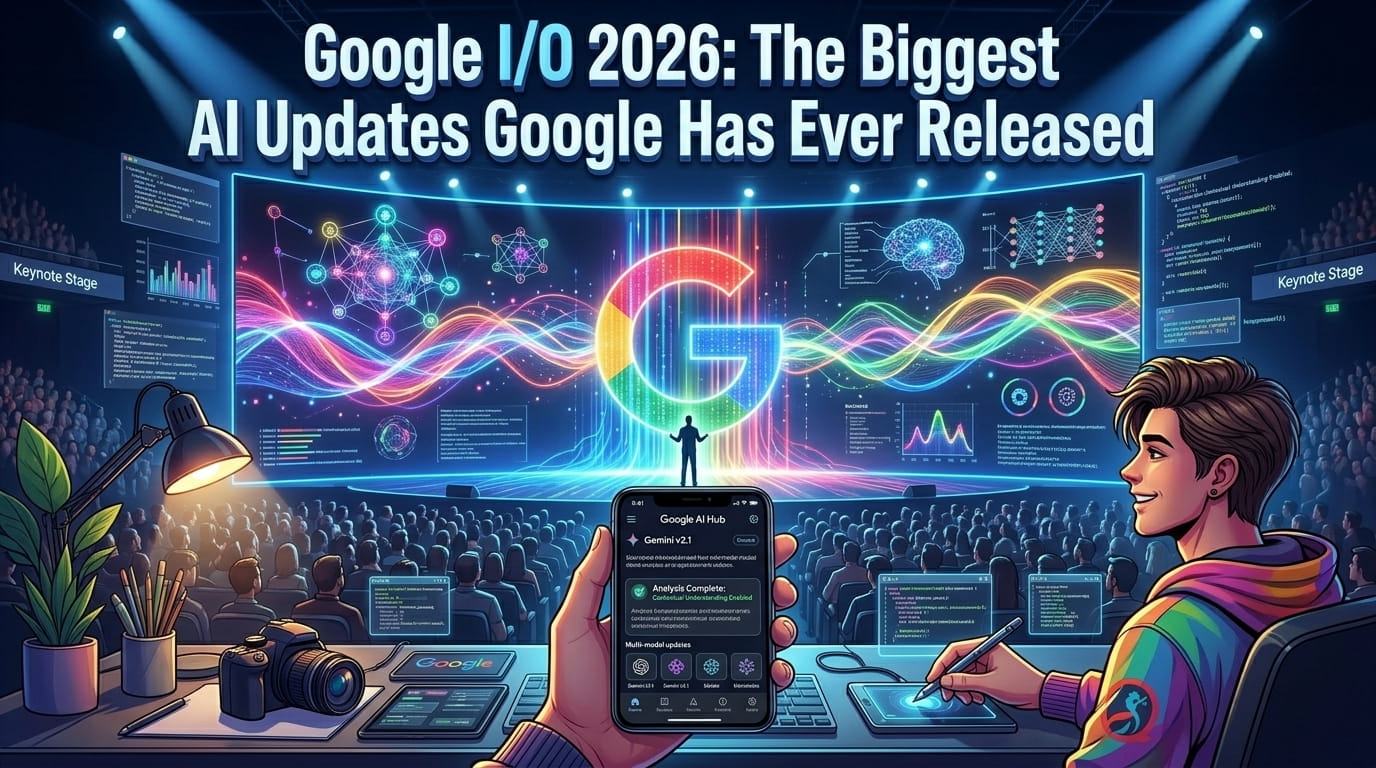
Google I/O just had one of its biggest moments in tech history. At this year’s Google I/O event, the company revealed more than 20 major AI updates in less than 24 hours. And honestly, it feels like Google is no longer just improving products. It is rebuilding the internet around AI.
From AI-generated videos and smart search experiences to futuristic smart glasses and autonomous AI agents, almost every Google product got an upgrade. Search, YouTube, Android, Chrome, Workspace, design tools, coding assistants — everything is now becoming AI-first.
What makes this event different is not just the number of announcements. It’s the direction. AI is no longer limited to generating text or answering questions. Google is pushing AI toward understanding the real world, taking actions for users, and even creating interactive environments.
Gemini Omni Flash Takes AI Video Generation to Another Level
One of the most exciting launches at Google I/O was Gemini Omni Flash. This is Google’s new multimodal AI model that can understand text, images, audio, and video together.
But the real highlight was its AI video generation capability.
Until now, most AI video tools required extremely detailed prompts and still struggled to create videos that truly understood the topic. Many looked visually impressive but lacked depth or factual accuracy.
Google is trying to change that completely.
With Gemini Omni Flash, users can provide a simple prompt along with media like images, audio clips, or existing videos, and the AI generates a polished video that actually understands the subject matter.
During the demo, Google asked the AI to create a claymation explainer about protein folding while keeping it scientifically accurate. The result included synchronized narration, realistic visuals, and accurate scientific explanations — all generated from a single prompt.
This could become huge for:
- YouTube creators
- Educational channels
- Marketing agencies
- Social media creators
- Online teachers
AI video generation is finally moving beyond “cool-looking clips” into genuinely useful content creation.
Google Search Has Changed More Than Ever Before
Google I/O also redesigned Search in a massive way.
Search is no longer limited to typing text queries. Users can now upload:
- Images
- Videos
- Files
- Chrome tabs
Google’s AI analyzes everything together and generates interactive answers instead of only showing traditional blue links.
For example, users can now:
- Generate astrophysics simulations
- Build interactive dashboards
- Create custom fitness trackers
- Visualize how devices work
The search results page itself becomes dynamic and personalized.
This is a major shift because Google Search is slowly evolving from a search engine into an AI assistant that builds experiences in real time.
For website owners and bloggers, this also means content quality matters more than ever. Simple information may get summarized instantly by AI, so unique insights and real expertise will become increasingly important for SEO.
AI Agents Are Now Built Into Search
Another major announcement was the introduction of AI agents directly inside Google I/O Search.
These agents can continuously monitor tasks on behalf of users.
For example, users can ask Google to:
- Track sneaker releases
- Monitor ticket availability
- Watch price drops
- Find restaurant reservations
- Send alerts for specific events
Instead of searching manually every day, the AI agent handles the monitoring automatically and sends updates when needed.
This changes the entire role of search engines.
Search is no longer just about finding information. It’s becoming about delegating tasks to AI systems that actively work for you in the background.
Gemini Spark Could Become Your Personal AI Assistant
Google I/O also introduced Gemini Spark, a personal AI assistant deeply connected with Google Workspace.
This tool can:
- Monitor emails
- Check calendars
- Manage reminders
- Suggest purchases
- Flag subscriptions
- Coordinate schedules
One example shown during the presentation involved the AI noticing a school event in a child’s calendar and automatically preparing snack suggestions for Instacart.
The important part here is integration.
Because Gemini Spark connects with Gmail, Docs, Slides, and other Google services, it can actually complete tasks instead of simply giving suggestions.
That makes it feel much closer to a real digital assistant.
Daily Brief Wants to Simplify Your Entire Morning
Google I/O also launched a feature called Daily Brief.
Every morning, Gemini can scan your apps and create a personalized summary using information from:
- Gmail
- Calendar
- Notifications
- Upcoming meetings
- Follow-ups
Instead of checking multiple apps individually, users receive one organized briefing that prioritizes urgent tasks first.
For professionals, freelancers, creators, and business owners, this could save a surprising amount of time every single day.
Google’s AI Coding Tool Looks Extremely Powerful
One of the most impressive demonstrations at the event was Anti-Gravity 2.0.
This is Google’s AI-powered development environment that can build software with minimal human input.
Google demonstrated this by creating a cyber-themed self-playing Chrome Dino game using a single text instruction.
The AI:
- Planned the project
- Designed the visuals
- Created gameplay logic
- Fixed coding errors
- Improved performance automatically
When the game initially failed to load, the AI investigated the problem and corrected it on its own without requiring extra prompts.
This feels like a huge step toward autonomous software creation.
While developers are still essential, tools like this may dramatically lower the barrier for beginners and non-programmers to create working applications.
Stitch Is Becoming a Serious AI Design Tool
Google I/O also upgraded Stitch, its AI-powered design platform.
Several major features were added.
Live Streaming Design Generation
Designs now appear in real time while AI generates them, allowing users to guide the process instantly.
Import Existing Designs
Users can now import:
- Figma files
- Existing websites
- Codebases
Instead of starting from scratch.
Edit Individual Elements With AI
Users can highlight specific sections of a design and modify only those parts without regenerating the entire layout.
Real Animations Inside Prototypes
Stitch now supports real animations directly inside prototypes instead of static mockups.
Better Export Options
Projects can now export directly to platforms like:
- Netlify
- Bolt
- Lovable
For startup founders and indie developers, this could significantly speed up the design-to-launch workflow.
Google’s New AI Image Tool Could Challenge Canva
Google I/O also introduced Picks, an AI-powered image editing platform.
Unlike normal AI image generators, Picks treats every object separately inside the image.
That means users can:
- Move objects independently
- Resize elements
- Edit text directly
- Translate text while preserving fonts
- Collaborate live with other users
This feels much closer to professional editing software than traditional prompt-based image generators.
For creators and designers, this could become an incredibly useful workflow tool.
AI Music and Video Editing Gets Smarter
Google I/O also launched Flow Music powered by Lyria 3 Pro.
This tool allows creators to edit specific sections of songs without affecting the entire track.
For example, users can:
- Replace beat drops
- Change instruments
- Convert music genres
- Preserve vocals while changing style
Video editing also received major upgrades.
Users can now modify scenes using plain English instructions like:
- Change day to night
- Replace outfits
- Maintain character consistency
- Edit shots without full re-rendering
This could become extremely useful for YouTubers, filmmakers, musicians, and social media creators.
Google’s Smart Glasses Could Compete Directly With Meta
Google I/O and Samsung also showcased AI-powered smart glasses during the event.
The glasses support:
- Voice assistance
- Navigation
- Calls and messages
- Taking photos
- Restaurant reviews
- Real-time visual overlays
Powered by Android XR, these glasses are clearly designed to compete with Meta’s Ray-Ban smart glasses.
Many tech companies now believe wearable AI devices may eventually become more important than smartphones.
And honestly, after seeing these demos, that future does not feel very far away anymore.
Gemini 3.5 Is Powering Almost Everything Google Built
Google I/O also introduced Gemini 3.5 Flash, the AI model powering many of these new features.
According to Google, Gemini 3.5 is:
- Faster
- Cheaper
- Better at coding
- Better at reasoning
- Better at multimodal tasks
The company claims it performs significantly faster than previous models while costing much less to run.
That matters because cheaper AI models usually lead to wider adoption across apps and platforms.
The Biggest Takeaway From Google I/O 2026
The biggest thing Google revealed at I/O 2026 is not just individual tools.
It’s the strategy behind all of them.
Google I/O is no longer adding AI as a feature. It is rebuilding its entire ecosystem around AI.
Search, YouTube, Android, Workspace, Chrome, design tools, coding systems, and even hardware are becoming part of one connected AI-driven experience.
And with billions being invested into AI infrastructure, this transformation is probably only getting started.
Frequently Asked Questions
What was the biggest announcement at Google I/O 2026?
Gemini Omni Flash and the redesigned AI-powered Google Search were among the biggest announcements because they completely change how users interact with AI and the internet.
What is Gemini Omni Flash?
Gemini Omni Flash is Google’s multimodal AI model capable of understanding text, images, audio, and video together while generating accurate AI videos and interactive experiences.
Are Google’s AI tools free?
Some tools are launching free globally, while others may later include premium plans or enterprise features.
What are Google AI agents?
AI agents are assistants that can monitor tasks, track updates, and perform actions automatically without requiring repeated user input.
Will AI replace traditional Google Search?
Not completely, but Google Search is evolving from simple links into interactive AI-generated answers and personalized experiences.
Are Google smart glasses available now?
The smart glasses were showcased at Google I/O but have not fully launched globally for public purchase yet.